

Cast your mind back to the early 2000s. A small business owner — let’s call her Priya — ran a boutique travel agency in Mumbai. Every morning, she would arrive before 9 AM, unlock the glass door, and sit by a telephone that rang all day. Customers called to ask about flight timings, hotel availability, visa requirements. Priya and her two assistants would answer the same questions, on loop, with a smile.
When the office closed at 7 PM, the questions didn’t stop. They just went unanswered. Potential customers drifted away into the night, their money going elsewhere.
That world feels like a different planet now.
Today, Priya’s equivalent — a solo travel entrepreneur — has an AI chatbot answering 300 queries simultaneously at 2 AM while she sleeps. The phone never rings, because the bot already handled it. The world didn’t just change. It accelerated past us while we were busy being nostalgic.
Your Customers Don’t Sleep — Neither Should Your Business

What Exactly Is an AI Chatbot? (And Why Should You Care?)
An AI chatbot is not the clunky, frustrating pop-up that once asked “Can I help you?” and then failed spectacularly to do so. That generation is gone. Today’s AI-powered conversational agents are built on large language models, natural language processing, and machine learning — capable of understanding context, tone, and intent with remarkable precision.
Think of it this way: if the old chatbot was a vending machine, the new one is a well-trained, empathetic customer service executive who never sleeps, never takes lunch, and never has a bad day.
The numbers back this up:
- The global chatbot market was valued at $7.76 billion in 2023 and is projected to reach $27.3 billion by 2030 (Grand View Research).
- 88% of customers had at least one conversation with a chatbot in 2022 (Tidio).
- Response time drops from an average of 11 hours (human email) to under 3 seconds (AI chatbot).
Let’s solve your SEO problem together

The Emotional Pull: We Didn't Lose the Human Touch, We Scaled It
Here’s the irony that took most people by surprise: AI chatbots didn’t kill empathy in customer service — they actually freed humans to be more empathetic.
When a chatbot handles the repetitive, transactional questions — “What is your return policy?” “Is this available in blue?” “Where is my order?” — the human agents are left with what they do best: handling emotionally complex, nuanced conversations that genuinely require a human heart.
There is something bittersweet in this shift. Many of us remember the warmth of calling a company and hearing a familiar voice. That experience isn’t dead. It’s just been reserved for moments when it matters most.
- Chatbots handle the volume. Human agents handle the value.
- Bots respond at 3 AM. Humans respond with wisdom at 3 PM.
- AI captures the lead. People close the deal.
This division of labour isn’t dehumanising. It’s actually more human than anything that came before it.

The Companies Cashing In — And What They're Doing Right
The proof, as always, is in the profit. Let’s talk about the brands that have turned AI chatbots into legitimate growth engines.
Sephora deployed an AI chatbot that guides customers through product recommendations and skin consultations. The result? A measurable increase in booking rates and a significant boost in average order value.
H&M uses a conversational bot to help shoppers find outfits based on their style preferences. It reduced the load on support staff while simultaneously improving the customer experience — a rare double win.
Domino’s Pizza introduced “Dom,” an AI ordering chatbot available across Facebook Messenger, Alexa, and their own app. The company reported that digital orders — many facilitated by the bot — now account for over 65% of total sales in several markets.
Bank of America’s Erica became one of the most widely used financial chatbots, crossing 2 billion interactions in a few years. It doesn’t just answer questions — it proactively notifies customers about spending patterns and potential savings.
Zara, Airbnb, Uber, and Amazon have all integrated AI-powered conversational tools into their customer journey with measurable returns on investment. These are not experiments. These are deliberate, profitable strategies.
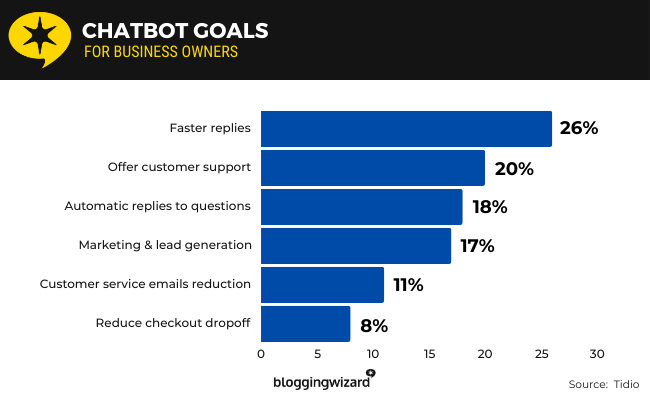

The 24/7 Advantage: When Time Zones Become Irrelevant
One of the most underappreciated advantages of AI chatbots is something deceptively simple: they never close.
In a globalised economy, your customer in Toronto might discover your product at midnight while your team in Bengaluru is asleep. In the old world, that customer would leave. In the new world, the chatbot greets them, answers their questions, captures their details, and often closes the sale — all before sunrise.
Here’s what that means in practice:
- Lead capture increases by up to 40% when chatbots are deployed outside business hours (Drift).
- Customer satisfaction scores improve when wait times are eliminated.
- Cart abandonment rates drop when bots re-engage hesitant shoppers in real time.
- Repeat purchase rates rise when post-sale bots follow up with personalised recommendations.
The 24/7 engine doesn’t just work harder. It works smarter, learning from every interaction to improve the next one.

The Road Ahead: Not Robots, But Relationships
The future of AI chatbots is not a cold, transactional dystopia. The trajectory is moving towards what researchers are calling “emotionally intelligent AI” — systems that can detect frustration, adjust tone, and escalate to human agents at precisely the right moment.
Companies like Intercom, Drift, Tidio, and Zendesk are already building these emotionally adaptive systems. Salesforce Einstein is integrating chatbots deep into CRM workflows. HubSpot is using conversational AI to nurture leads through the full marketing funnel without a single human click.
The chatbot of tomorrow will not feel like a bot at all.
7 Ways AI Chatbots Are Actively Making Businesses More Money
- Capturing Leads Around the Clock
Every midnight visitor is a potential customer. A chatbot greets, qualifies, and drops them into your sales funnel — no lead left behind, ever.
- Reducing Support Costs Dramatically
Businesses spend $1.3 trillion annually on support calls. AI chatbots handle 80% of routine queries, slashing costs without compromising the quality of service.
- Personalising the Customer Journey
Modern chatbots remember behaviour, past purchases, and preferences. They serve recommendations that feel genuinely personal — not robotic, not generic, not lazy.
- Cutting Cart Abandonment Rates
One timely message — “Need help deciding?” — recovers up to 25% of abandoning carts. That single chatbot nudge directly translates into recovered revenue.
- Booking Appointments Without Human Involvement
Chatbots schedule, reschedule, and send reminders autonomously. Platforms like Zocdoc and Calendly have built profitable ecosystems entirely around this one powerful function.
- Gathering Customer Feedback Effortlessly
Bot-driven surveys see 3x higher response rates than emails. That data flows straight into dashboards, shaping smarter product and marketing decisions daily.
- Scaling Without Hiring
Humans handle 10 conversations simultaneously. One AI chatbot handles 10,000. For a growing business, that scalability is not convenience — it is survival.

Final Thought: Priya Doesn’t Miss the Telephone
Back to Priya. I met a real version of her recently — a young entrepreneur running an online coaching business. She told me something that stuck with me:
“My chatbot follows up with leads I forgot about three weeks ago. It sends them exactly what they needed. And then they come to me ready to buy. I feel like I have a business partner who never asks for a salary.”
That is the quiet, unglamorous, deeply practical magic of AI chatbots. Not science fiction. Not a tech buzzword. Just a tool — like electricity once was — that the smart businesses adopted early and the rest of the world will eventually wonder how they ever lived without.
The phone may have stopped ringing. But the conversations never stopped. They just got better.
Bigpage can help you to grow your business digitally through well-defined website content, building an NGO Website, Dynamic website for you to enhance your online presence and get more clients through various Facebook, Instagram Ads

Agrodut is a managing director and seasoned digital marketing specialist passionate about SEO. With 15 years of experience, he has helped numerous businesses elevate their online presence and achieve higher search engine rankings. A results-driven professional, Agrodut Mondal stays updated with the latest SEO trends and best practices to ensure cutting-edge strategies. When not optimising websites, he enjoys exploring new technology and sharing insights through writing and speaking engagements. Connect with Agrodut for expert guidance on unlocking your website’s full potential in the digital.