
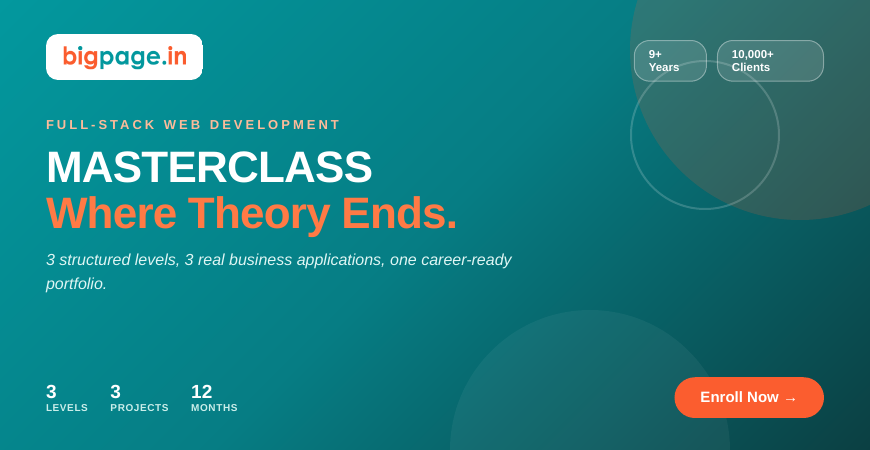
Every year, thousands of students in India sign up for coding bootcamps hoping to land a developer job — and every year, a large chunk of them quit halfway because the course felt more like a video lecture library than a launchpad. Bigpage is pitching something different: a 12-month, three-level program built by a working IT agency with 9+ years in the field and 10,000+ client projects behind it, not by a curriculum committee that’s never shipped a live product. Here’s a breakdown of what the Bigpage Masterclass offers, how it stacks up, and what to expect once you finish.
Why Learn Full-Stack Development Right Now?
Tech hiring has changed. Companies aren’t just looking for someone who can build a homepage or write a database query — they want one person who can move across the entire application. That shift is exactly why full-stack roles sit near the top of India’s tech hiring charts, and why the pay reflects it: freshers with a solid portfolio commonly start between ₹3.5–7 LPA, climbing to ₹6–12 LPA within two to five years for developers who can genuinely handle a project end to end.
Why the Bigpage Masterclass Focuses on Portfolios Over Certificates ?
-
The Bigpage Masterclass is structured differently, offering a 12-month program that is divided into three distinct levels
-
Each level revolves around building a live project, allowing students to create a student registration system, a library platform, and a hospital management system
-
These aren’t basic exercises; they are the kind of applications businesses actually pay for, featuring complex additions like role-based logins and built-in billing
-
Ultimately, graduates finish the course with a complete portfolio, giving them tangible proof that they can build software that actually works rather than just holding a piece of paper
Start learning journey with Bigpage
What Sets This Masterclass Truly Apart

An Agency-Led Model, Not a Classroom Model
Most coding institutes are staffed by trainers who teach syllabus content but haven’t built and deployed commercial software themselves. Bigpage flips that: the people designing the curriculum run an active agency handling business applications, digital marketing, and SEO work for real clients. That changes what gets taught — less abstract theory, more of the messy, practical decisions developers make under deadline pressure.
- Instruction is drawn from live project workflows, not textbook chapters
- Students work on the same categories of systems the agency delivers to paying clients
- The course folds in the “business and marketing” layer most bootcamps skip entirely
- Emphasis on shipping deployed, working software rather than isolated exercises
- Curriculum has been refined across nearly a decade of client-facing projects
This agency-first approach is Bigpage’s core differentiator versus traditional academies, where instructors often teach from standardized slide decks updated once a year.

A Three-Level, Project-Driven Curriculum
Instead of one long syllabus, the program is split into three four-month levels, each anchored by a single deployed application. This mirrors how junior developers actually grow on the job — one real system at a time, with increasing responsibility.
- Beginner (4 months): Student Registration System — HTML5, PHP, MySQL, full CRUD, live search
- Advanced (4 months): Online Library Management System — authentication, relational databases, file uploads, SQL joins, admin analytics
- Professional (4 months): Hospital Management System — role-based access control, booking engines, billing logic, master admin console
- Every level ends with a fully deployed, functioning application, not a static prototype
- Progression is cumulative, so complexity builds on skills already proven in the prior level
By the 12-month mark, a student has three separate live projects to show — which matters more to recruiters than a single certificate.

Technical Skills You'll Actually Walk Away With
Employers scanning resumes for full-stack roles look for specific, demonstrable capabilities, not vague phrases like “web development knowledge.” Bigpage’s syllabus maps closely to what’s actually tested in technical interviews for junior-to-mid full-stack roles.
- Core web fundamentals: HTML5 layouts, PHP scripting, MySQL database design
- Security practices: password hashing, session management, access validation
- Data operations: full CRUD systems, multi-table SQL joins, sortable and searchable interfaces
- Enterprise patterns: role-based access control (RBAC), booking and billing systems, admin dashboards
- Deployment: taking a local build to a live, production-ready application
Compared to shorter 6–8 week bootcamps that rush through frameworks without depth, this 12-month pacing gives each concept enough runway to actually stick — a common gap flagged in hiring feedback for rushed-format graduates.

Where This Fits Into the Current Job Market
Full-stack hiring in India isn’t slowing down, but it has gotten more selective. Companies increasingly want developers who can move across the entire stack independently rather than narrow specialists who need constant supervision. Fresher salaries generally sit in the ₹3.5–7 LPA band, with strong portfolios pushing that toward ₹8–10 LPA at product-focused companies, and mid-level professionals with two to five years of experience commonly reaching ₹6–12 LPA or higher.
- A three-project portfolio directly addresses the “show, don’t tell” expectation recruiters now have
- PHP and MySQL remain widely used in India’s services sector, particularly SMBs and agencies — Bigpage’s actual client base
- RBAC, billing systems, and admin dashboards mirror what’s used in enterprise-facing internal tools
- Developers comfortable across front end, back end, and database layers tend to negotiate better starting offers
- Practical deployment experience shortens the ramp-up time employers usually budget for new hires
The gap between “I learned to code” and “I can be handed a business problem and ship a solution” is exactly what this project-based structure is trying to close.

What Happens After You Finish: Career Support
A 12-month technical program is only half the value proposition — the other half is what happens once the syllabus ends. Because Bigpage operates as a functioning agency alongside its training arm, graduates aren’t just handed a certificate and sent off; the same organization that built the curriculum also builds client software year-round, which creates a more direct line between training and employability.
- A completed three-project portfolio ready to present in interviews from day one
- Direct exposure to how real businesses use custom software, which sharpens interview conversations beyond syntax
- Skills mapped to what agencies and SMB-focused companies specifically hire for
- A learning path structured around outcomes employers can verify, not just attendance
- Continuity with an active industry network built over 9+ years and 10,000+ client engagements
Quick Recap: Why Students Choose Bigpage Over a Traditional Academy
Course length, project count, and instructor background rarely tell the full story, so here’s what actually separates this program from a standard institute.
- Mentors: Trainers are practicing developers running a live agency, not full-time lecturers
- Projects: Three deployed applications instead of disconnected practice exercises and quizzes
- Experience: Curriculum shaped by 10,000+ real client engagements across 9+ years
- Context: Direct coverage of business and marketing context most bootcamps ignore
- Relevance: Skill sequencing matched to what junior developer interviews actually test
- Pacing: Slower, 12-month pacing built for retention rather than a rushed certificate
- Outcome: A portfolio-first result instead of a participation-based completion certificate.

Conclusion
If you’re deciding between a generic six-week bootcamp and a slower, deeper, agency-run program, the trade-off comes down to this: speed versus depth. Bigpage is betting that twelve months of real, deployed, business-relevant projects will outperform a rushed certificate — and given how selective full-stack hiring has become in 2026, that bet lines up with where the market is heading. If your goal is a portfolio recruiters take seriously rather than a certificate that sits in a drawer, this structure is worth a closer look.
Bigpage can help you to grow your business digitally through well-defined website content, building an NGO Website, Dynamic website for you to enhance your online presence and get more clients through various Facebook, Instagram Ads

Agrodut is a managing director and seasoned digital marketing specialist passionate about SEO. With 15 years of experience, he has helped numerous businesses elevate their online presence and achieve higher search engine rankings. A results-driven professional, Agrodut Mondal stays updated with the latest SEO trends and best practices to ensure cutting-edge strategies. When not optimising websites, he enjoys exploring new technology and sharing insights through writing and speaking engagements. Connect with Agrodut for expert guidance on unlocking your website’s full potential in the digital.