
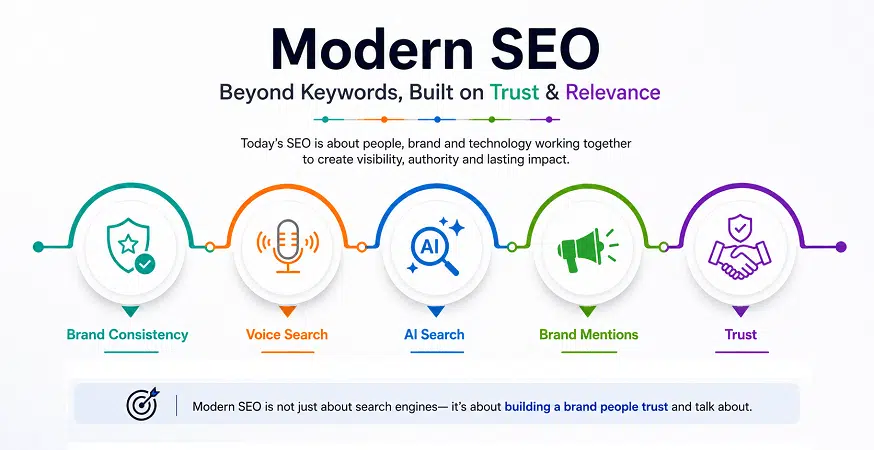
For years, SEO was a keyword game. Stuff the right words in the right places, get the right rankings. Simple.
Not anymore. Google’s algorithm has evolved dramatically. AI-powered search engines now analyse meaning, context, and credibility — not just keywords. And in this new landscape, one thing is quietly becoming the most powerful ranking signal of all: your brand voice.
Consistent brand presentation increases revenue by 23–33% across all channels — and that same consistency is now directly feeding into how search engines perceive and rank your content. The brands winning in 2026 aren’t just optimising pages. They’re building recognisable, trusted identities that Google actually wants to show users.
The Shift Every Smart Marketer Needs to Know
What Brand Voice Actually Means in 2026
Brand voice isn’t your logo or your colour palette. It’s the personality behind every word you publish — the tone, the language, the values that make your content feel unmistakably you.
And it’s now a core SEO signal.Google’s focus on Experience, Expertise, Authoritativeness, and Trustworthiness (E-E-A-T) continues to shape rankings — establishing credibility through authentic authorship and transparent sourcing is no longer optional, it is a ranking requirement.
Why Keywords Alone Are No Longer Enough
The old playbook is breaking down — fast. Gartner predicts that search engine volume will drop 25% by 2026 because of generative AI. Meanwhile, over 58% of all Google queries in the US are now zero-click searches — meaning users get answers without ever visiting a website.
In this environment, being found isn’t enough. You need to be recognised and trusted. That requires a brand voice strong enough to stand out the moment your content appears — whether in a search snippet, an AI Overview, or a social feed.
Let’s solve your SEO problem together

Brand Consistency Directly Impacts Rankings
Search engines reward brands they trust. And trust is built through consistency — in tone, messaging, and content quality across every touchpoint.
68% of companies report 10–20% revenue growth directly from brand consistency initiatives. That growth doesn’t happen in a vacuum — it’s powered by increased visibility, higher click-through rates, and stronger domain authority built over time.
Here’s what consistency does for your SEO:
- Builds topical authority — Google begins associating your brand with specific subjects
- Reduces bounce rates — familiar, trusted voices keep readers engaged longer
- Earns more branded searches — a signal Google treats as a major trust indicator
- Improves E-E-A-T scores across your entire domain
- Attracts higher-quality backlinks from publications that recognise your authority
HubSpot is a masterclass in this. Their blog maintains an unmistakably consistent educational tone across thousands of articles — and it’s helped them dominate organic search in the marketing space for over a decade.

Voice Search is Rewriting the Rules of Discoverability
Voice search isn’t a trend anymore — it’s a mainstream behaviour, and it demands a conversational brand voice to match.
Around 8.4 billion voice assistants are expected to be in use globally, and more than 1 billion voice searches take place every month. The way people search by voice is fundamentally different from how they type.
Voice search queries average 29 words, while text searches use just 3–4 words. Users speak more naturally in voice searches. That means brands writing in stiff, keyword-heavy prose are invisible in voice results.
What voice search rewards:
- Conversational, natural-sounding content that mirrors how people actually speak
- Clear, direct answers placed early — before elaborating
- FAQ-style content that matches spoken question formats
- Consistent tone across all pages so AI assistants can identify your brand reliably
- Local, specific language that aligns with “near me” and intent-driven queries
Domino’s Pizza pioneered voice-ordering through Alexa and Google Assistant — not just as a tech gimmick, but as a deliberate brand extension. Their casual, friendly voice translated perfectly to audio-first experiences.

AI Search Is Choosing Brands It Recognises
Google’s AI Overviews and tools like ChatGPT and Perplexity are now surfacing content directly in responses — and they don’t pick randomly. They pick brands they recognise as authoritative and consistent.
83% of marketers at companies with 200+ people report that their efforts to incorporate AI into their work are already driving better SEO performance. The brands getting cited in AI-generated answers share one thing: a clear, consistent, expert voice that signals credibility.
Avoid generic or shallow content easily summarised or overlooked by AI. Nurture trust over time with thoughtful, relevant, and in-depth content — this approach deepens engagement and strengthens your brand’s SEO authority.
Salesforce consistently invests in thought leadership content — whitepapers, long-form guides, and expert-authored blogs written in a confident, knowledgeable tone. The result? They dominate AI-generated business software recommendations.


Brand Mentions Are the New Backlinks
Links still matter. But brand mentions — even without a hyperlink — are quietly becoming one of the most powerful off-site SEO signals.
Brand mentions SEO refers to how often your business name appears across the web, even without a direct link. These “implied links” are massive clues for search engines — if your brand is frequently mentioned on industry forums, social media, and news sites, it signals that you are a topic of conversation.
A distinctive brand voice makes this happen naturally. When your content sounds like no one else’s, people quote it, share it, and reference it — without you asking.
Here’s how strong brand voice generates mentions:
-
- Unique opinions and takes that journalists and bloggers want to cite
- A recognisable writing style that gets shared across social platforms
- Community-driven conversations triggered by content that resonates
- Industry-specific authority that earns coverage in niche publications
- Word-of-mouth amplification when readers feel genuinely connected to your voice
Patagonia has built an entire SEO ecosystem on this principle. Their uncompromising, activist brand voice generates constant organic mentions across environmental, retail, and business publications — without a single paid placement.

Trust is a Ranking Signal — and Voice Builds Trust
77% of consumers make purchasing decisions based on brand name alone — and that brand recognition starts with familiarity. Familiarity starts with a voice people hear repeatedly and come to trust.
A brand with recognition, authority, and consistency doesn’t just rank — it dominates. It earns media coverage, sparks conversations, and builds lasting relationships with customers. And Google is paying attention.
Mailchimp is one of the most cited examples of brand voice done right. Their famously quirky, approachable tone built massive audience loyalty — which translated directly into organic traffic, branded searches, and strong domain authority.
Brands Getting This Right in 2026
Several companies have made brand voice a core pillar of their digital growth strategy — and the SEO results speak for themselves.
- HubSpot — consistent educational tone across 10,000+ articles fuels industry-leading organic traffic
- Salesforce — expert-led content in a confident voice dominates AI-generated B2B recommendations
- Patagonia — activist brand voice generates continuous organic media mentions globally
- Mailchimp — distinctive quirky tone built one of the strongest branded search presences in SaaS
- Nike — motivational, human-first voice earns billions of social mentions that amplify SEO reach
How to Build a Brand Voice That Ranks
Getting this right doesn’t require a brand strategy agency. It requires intention, consistency, and a clear understanding of who you’re talking to.
Start here:
- Define 3–5 voice attributes — words that describe how your brand sounds (e.g., bold, warm, direct, expert, playful)
- Create a simple style guide — tone dos and don’ts, approved vocabulary, and examples of your voice done right
- Audit your existing content — does everything you’ve published sound like the same brand? If not, fix the gaps
- Write for humans first — natural, conversational language performs better in both voice search and AI-generated results
- Be consistent everywhere — your blog, your social captions, your meta descriptions, your emails should all sound like you

Conclusion
Keywords can be copied. Tactics can be replicated. But a genuine, recognisable brand voice? That’s yours alone.
The future of SEO in 2026 belongs to those who focus on quality, people-first content — content that feels human, authoritative, and worth listening to.
The brands winning aren’t just ranking higher. They’re building something no algorithm update can take away — a reputation that earns attention, trust, and loyalty at scale.
Stop chasing keywords. Start owning your voice
Bigpage can help you to grow your business digitally through well-defined website content, building an NGO Website, Dynamic website for you to enhance your online presence and get more clients through various Facebook, Instagram Ads

Agrodut is a managing director and seasoned digital marketing specialist passionate about SEO. With 15 years of experience, he has helped numerous businesses elevate their online presence and achieve higher search engine rankings. A results-driven professional, Agrodut Mondal stays updated with the latest SEO trends and best practices to ensure cutting-edge strategies. When not optimising websites, he enjoys exploring new technology and sharing insights through writing and speaking engagements. Connect with Agrodut for expert guidance on unlocking your website’s full potential in the digital.