
Customer experience used to be simple — pick up the phone, smile, and resolve the issue. Not anymore.
Today’s customers expect instant answers, personalised interactions, and round-the-clock availability. And businesses that fail to deliver? They lose — fast.
That’s exactly where Artificial Intelligence steps in. AI isn’t just a support tool anymore. It’s becoming the backbone of how companies engage, retain, and delight their customers. In 2026, the AI customer service market has already reached $12.06 billion, and it’s projected to hit $47.82 billion by 2030 — growing at a staggering pace.
The playbook is being rewritten. Here’s how.
The Future of Customer Experience Is Already Here
Why AI and Customer Experience Are a Perfect Match
Think about the last time you had a frustrating customer service experience — long wait times, repeated explanations, zero personalisation. That’s the old model.
In 2026, 95% of customer interactions are predicted to be handled by AI, and 75% of customer inquiries can now be resolved by AI tools without any human intervention. That shift isn’t coming. It’s already here.
Service professionals save over 2 hours daily by using generative AI for quick responses, and 60% of support leaders say they are most excited about faster response times. The productivity gains alone are hard to ignore.
Let’s solve your SEO problem together

Hyper-Personalisation at Scale
Gone are the days when “Dear Customer” was enough. Today, customers want you to know them — their preferences, their history, their needs — before they even explain it.
AI makes that possible, and at scale.
64% of customer service reps using AI say it helps them personalise their messages to customers. What used to require hours of manual data analysis now happens in milliseconds.
Here’s how AI powers personalisation:
- Analyses past purchase behaviour to recommend relevant products in real time
- Tailors communication tone and channel based on individual customer preferences
- Predicts future needs before customers even raise them
- Segments audiences dynamically, adjusting messaging across touchpoints
- Triggers proactive outreach when patterns suggest a potential issue or opportunity
Amazon is perhaps the most cited example. Its AI-driven recommendation engine accounts for a significant portion of its total revenue — and Amazon delivered 60% of orders to Prime members on the same or next day in 60 top US metro areas as of March 2024. That’s not just logistics. That’s AI-powered customer experience at its finest.

Intelligent Chatbots and Virtual Assistants
Chatbots used to be a joke — clunky, robotic, and utterly unhelpful. Modern AI-powered assistants are a completely different story.
Klarna introduced an AI customer service assistant powered by OpenAI in early 2024. Within its first month, it managed a workload equivalent to 700 full-time agents.
The results were remarkable:
- Repeat inquiries fell by 25% due to greater accuracy in task resolution
- Customers resolved problems in under 2 minutes, compared to 11 minutes with human agents
- Customer satisfaction levels remained on par with human-handled interactions
- Klarna estimated these AI assistants would yield $40 million in additional profits in 2024
- The assistant expanded to include product research, comparisons, and price recommendations
Gartner forecasts that by 2027, chatbots will be the primary customer service channel for roughly 25% of all organisations. For many businesses, that future is already the present.

Predictive Intelligence: Solving Problems Before They Happen
One of the most underrated capabilities of AI in customer experience is its ability to predict issues — and act before the customer even notices.
Verizon uses generative AI to accurately predict the reason behind 80% of incoming service centre calls and then connect callers with a suitable human agent — staving off defection of an estimated 100,000 customers in 2024.
This predictive model shifts customer service from reactive to proactive:
- Identifies product defects or service issues early and alerts affected customers
- Reduces inbound call volumes by addressing concerns before escalation
- Routes complex queries to specialised agents, cutting resolution time dramatically
- Monitors customer sentiment signals to flag churn risk before it materialises
- Enables businesses to offer solutions — not just responses
This approach doesn’t just improve experience. It builds trust. 96% of consumers trust a brand more when companies make it easy to do business with them.

AI-Powered Agent Assistance: Empowering the Human Behind the Screen
AI isn’t just serving customers directly — it’s making human agents dramatically more effective.
In 2025, 80% of customer service and support organisations will use generative AI to improve agent productivity and overall customer experience, according to Gartner.
According to BCG, early adopters are reporting 80% savings in the time it takes to create case summaries, and agents spend 80% less time typing when resolving support requests — with productivity increases of 10% to 20%.
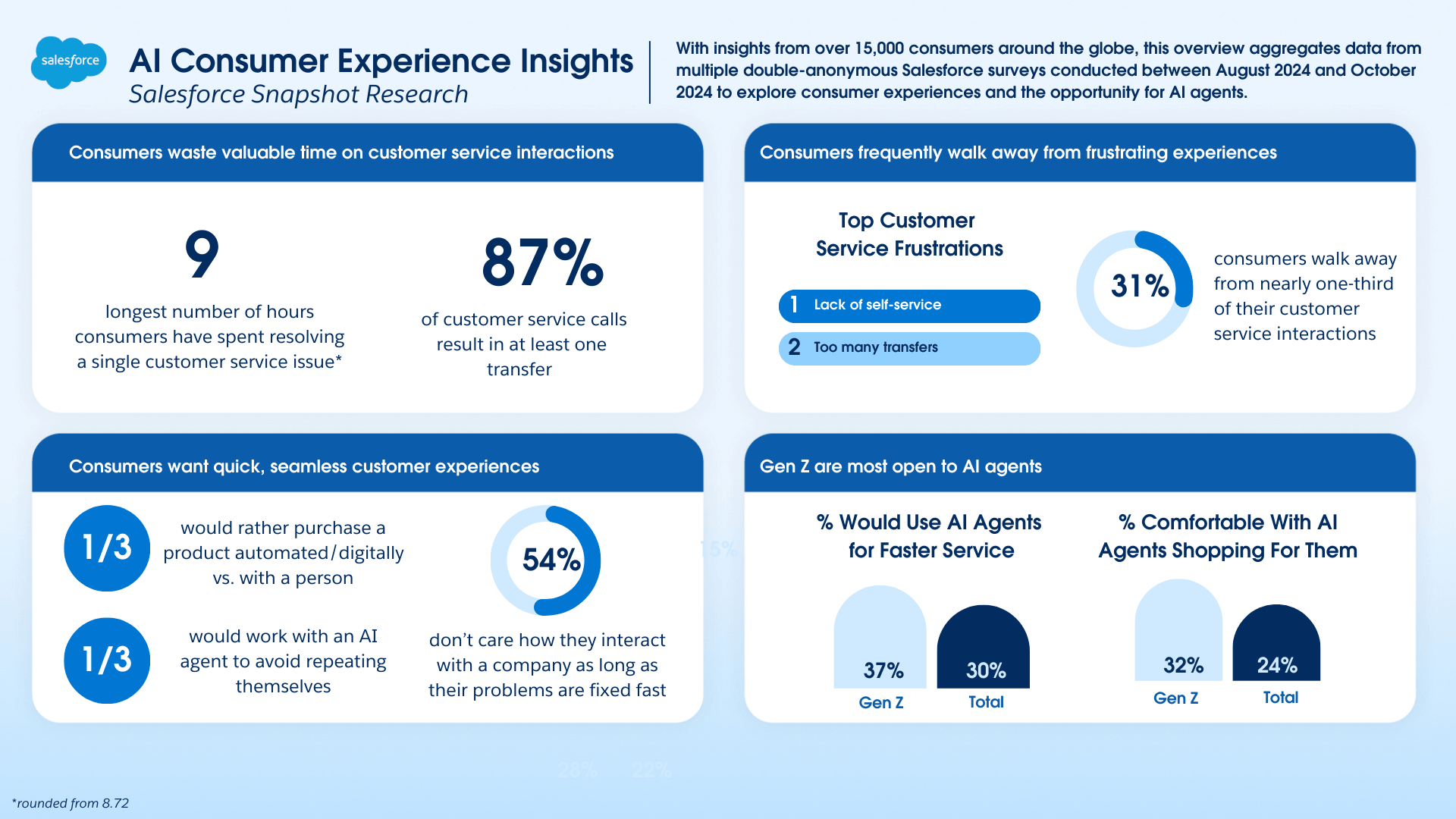
Salesforce has been a frontrunner here. Salesforce CEO Marc Benioff noted at Dreamforce 2024 that service employees waste over 40% of their time on low-value, repetitive tasks — precisely what AI is designed to eliminate, freeing agents to focus on empathy, complexity, and relationship-building.

Immersive and Sensory Customer Experiences
AI is also reshaping how customers discover and experience products — particularly in retail.
L’Oréal introduced virtual makeup try-ons as far back as 2018 using AI. The technology uses facial images from women of diverse ages and ethnicities to provide a superior colour match — something no physical store could replicate at scale.
Delta Airlines is taking a different approach entirely. Delta’s touchless ID uses biometric screening with facial recognition to check travellers in, print bag tags, and allow them through security without showing a boarding pass. It’s not just convenient — it’s a fundamentally different kind of experience.
These aren’t gimmicks. They represent a shift in how AI extends the customer journey beyond a screen.
What to Look for in an AI CX Tool
Choosing the right AI tool for customer experience isn’t about picking the most popular name — it’s about finding what actually fits your business needs and customer expectations. Here’s what to evaluate before you commit.
- Ease of Integration
It must connect with your existing CRM and helpdesk instantly. No complex setup, no heavy IT involvement — just plug and perform.
- Personalisation Capabilities
It should learn from real customer data. Every interaction must feel tailored, not templated.
- Scalability Without Compromise
It must handle 100 or 100,000 queries equally well. Performance should never dip as your business grows.
- Human Handoff Intelligence
AI must know when to step back. Context should transfer to human agents smoothly — no repetition, no friction.
- Reporting and Continuous Learning
It should get smarter with every interaction. Real-time dashboards and active feedback loops are non-negotiable.

Conclusions
The companies thriving in 2026 — Amazon, Klarna, Verizon, Salesforce, L’Oréal, Delta — aren’t just using AI as a cost-cutting tool. They’re using it to fundamentally redefine what a great customer experience looks like.
Over 80% of companies are either already using or planning to adopt generative AI for customer interactions. The question is no longer whether AI belongs in your CX strategy. It’s how quickly and effectively you can make it work for your customers.
The playbook has been rewritten. The only move left is to start playing by the new rules.
Bigpage can help you to grow your business digitally through well-defined website content, building an NGO Website, Dynamic website for you to enhance your online presence and get more clients through various Facebook, Instagram Ads

Agrodut is a managing director and seasoned digital marketing specialist passionate about SEO. With 15 years of experience, he has helped numerous businesses elevate their online presence and achieve higher search engine rankings. A results-driven professional, Agrodut Mondal stays updated with the latest SEO trends and best practices to ensure cutting-edge strategies. When not optimising websites, he enjoys exploring new technology and sharing insights through writing and speaking engagements. Connect with Agrodut for expert guidance on unlocking your website’s full potential in the digital.